
An appellate court reviews decisions made by lower courts instead of conducting a new trial. Judges examine the existing record and legal arguments for significant errors. They may uphold, reverse, modify, or send a case back for further proceedings.
Understanding that distinction matters after a civil judgment, criminal conviction, or another appealable decision. An appeal usually focuses on legal or procedural mistakes rather than dissatisfaction with the result. Different federal and state rules determine which decisions can be reviewed and when.
Appellate Court Key Facts
| Question | Quick answer |
|---|---|
| Main purpose | Review lower-court decisions for legal or procedural error |
| New trial? | Usually no |
| New evidence? | Generally no |
| Jury involved? | No |
| Typical federal panel | Three judges |
| Main materials | Trial record, briefs, legal authorities |
| Possible outcomes | Affirm, reverse, modify, vacate, or remand |
| Federal system | 12 regional circuits plus the Federal Circuit |
| Next possible level | State supreme court or U.S. Supreme Court, depending on the case |
Direct Answer
An appeals court reviews whether a lower tribunal applied the law correctly and followed required procedures. It normally relies on the existing record rather than new witnesses or evidence. Judges can affirm the result, reverse it, or return the case for additional proceedings.
Key Takeaways
- Appeals are reviews, not ordinary second trials.
- Legal briefs often carry more weight than courtroom testimony because witnesses usually do not appear again.
- Different issues receive different standards of review.
- Filing deadlines can determine whether an appeal proceeds at all.
- Federal and state appellate systems have separate procedural rules.
- Winning an appeal does not always mean winning the entire underlying case.
What Does an Appellate Court Do?
An appellate court determines whether a lower tribunal made an error requiring corrective action. Federal courts of appeals review decisions from U.S. district courts and certain federal agencies. State systems perform similar review under their own constitutions and statutes.
The reviewing judges normally work from materials created before the appeal began. Those materials can include pleadings, exhibits, transcripts, motions, orders, and the final judgment. The parties then explain their legal positions through written appellate briefs.
The reviewing tribunal usually does not decide which witness seemed more believable. Trial judges and juries are generally responsible for evaluating testimony and evidence firsthand. Appeals therefore concentrate heavily on law, procedure, and preserved issues.
Readers comparing trial advocacy with appellate work may also find Justibyst’s guide to a litigation and appeals lawyer useful. It explains how litigation develops before a dispute reaches appellate review. That background helps show why the trial record matters later.
Trial Court vs. Appeals Court

Trial and appellate proceedings perform different jobs within the judicial system. A trial court develops facts and applies law during the initial case. A reviewing court examines what happened afterward under defined legal standards.
| Feature | Trial court | Appeals court |
|---|---|---|
| Primary role | Decide the original dispute | Review the lower decision |
| Witness testimony | Common | Usually absent |
| New evidence | Presented and tested | Generally not accepted |
| Jury | Possible | No jury |
| Decision-makers | Judge or jury | Usually a panel of judges |
| Main written materials | Pleadings, motions, evidence | Record and appellate briefs |
| Core question | What happened and who prevails? | Did a reviewable error occur? |
This difference explains why an appeal is not a chance to rebuild an unsuccessful case. Missing evidence normally cannot be added because it might have strengthened one side. Parties usually must argue from the record already created below.
The distinction also affects the lawyer’s work. Trial counsel may focus on testimony, evidence, objections, and jury persuasion. Appellate counsel concentrates heavily on preserved errors, legal research, written briefing, and standards of review.
For more context, Justibyst explains the work of an appellate attorney throughout briefing and oral argument. Appellate representation can differ significantly from ordinary courtroom litigation. The lawyer must often identify a narrow legal issue within a large record.
How the U.S. Federal Appeals System Works
The federal judiciary has 94 district courts organized within 12 regional circuits. Each regional circuit has a U.S. Court of Appeals reviewing district-court decisions within that circuit. The Federal Circuit handles certain specialized matters under nationwide jurisdiction.
A federal appeal commonly begins after entry of an appealable judgment or order. The party seeking review generally files a notice of appeal. Court rules then govern the record, briefing schedule, motions, and other procedural requirements.
The appellant files arguments explaining why the challenged decision should change. The appellee responds and argues why the result should remain in place. A reply brief may then address arguments raised in the response.
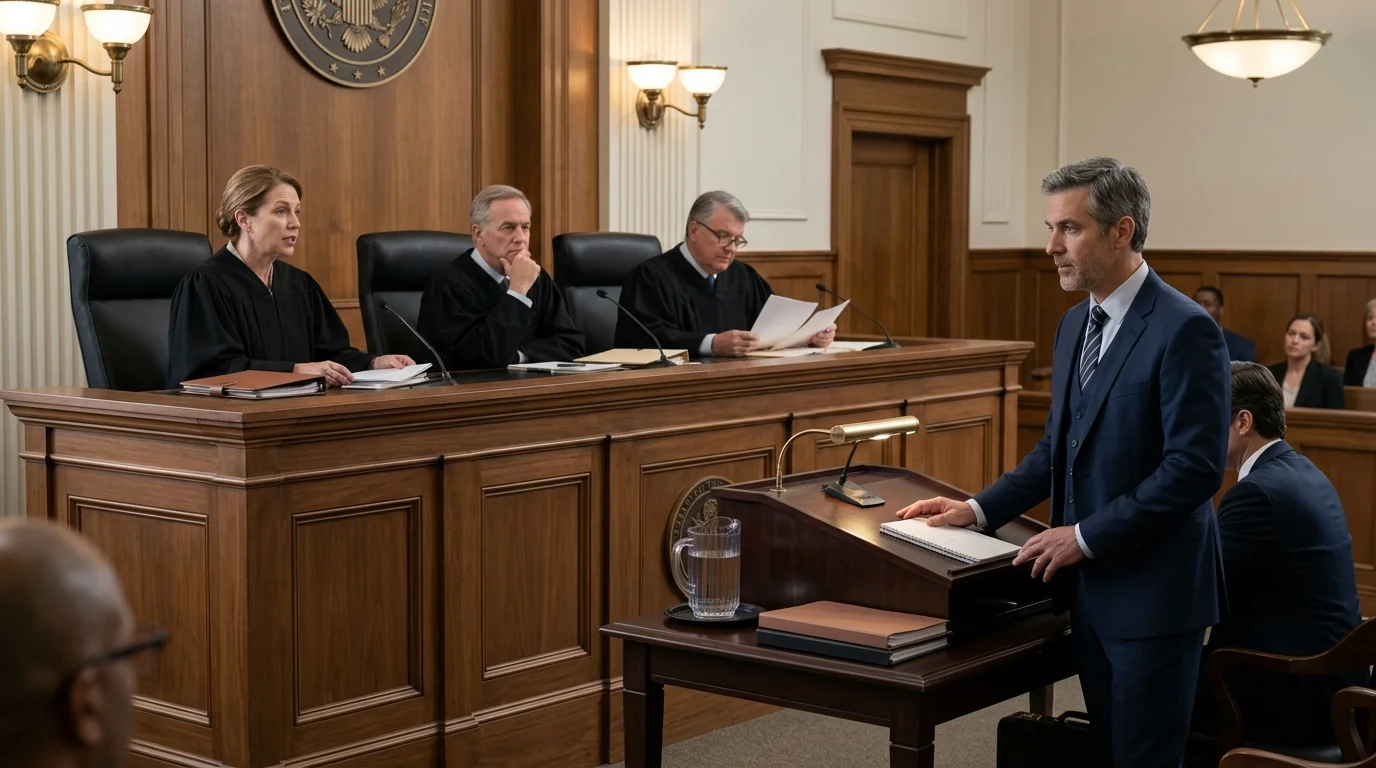
A panel often decides the case from the written record and briefs. Some cases receive oral argument before the judges. Oral argument lets lawyers answer questions and address issues troubling the panel.
Official information about the federal structure is available from the U.S. Courts. Federal procedure is governed by the Federal Rules of Appellate Procedure. Local circuit rules can impose additional requirements.
What Can Be Raised on Appeal?
Losing a case does not automatically establish a valid appellate issue. The reviewing court generally looks for an identifiable legal or procedural error. That error must also satisfy the applicable requirements for review.
Common appellate issues include:
- Applying the wrong legal rule.
- Misinterpreting a statute or constitutional provision.
- Giving improper jury instructions.
- Incorrectly admitting or excluding evidence.
- Making certain procedural rulings under an improper standard.
- Entering judgment without legally sufficient support.
- Violating constitutional or due-process protections.
An issue may also need to have been properly preserved before review. Lawyers often preserve objections by raising them at the appropriate point during trial proceedings. Failing to do so can restrict later arguments, although limited exceptions may apply.
This requirement makes the earlier litigation stage especially important. A lawyer handling contested proceedings must think about both the immediate ruling and the record being created. Justibyst’s explanation of what a litigator does provides useful background on that broader process.
Standards of Review Can Shape the Result
Not every issue receives the same level of scrutiny. The applicable standard tells the reviewing judges how much deference the lower decision receives. That standard can strongly affect how difficult reversal becomes.
Questions of law commonly receive de novo review in federal appellate practice. The reviewing judges examine the legal question without deferring to the lower court’s conclusion. This standard gives the panel greater freedom to reach its own legal interpretation.
Factual findings generally receive more deference. Certain factual decisions may be reviewed for clear error. Discretionary rulings can instead receive abuse-of-discretion review.
The U.S. Court of Appeals for the Ninth Circuit maintains an updated standards of review resource. Its materials illustrate how standards differ across issues. Lawyers must still verify the controlling law for the relevant jurisdiction and claim.
What Happens During the Appeal Process?
Although procedures differ, many appeals follow a recognizable sequence. Each court can impose separate filing rules and deadlines. Parties should therefore check the rules governing their exact case.
- Identify an appealable decision. Determine whether the judgment or order can currently be reviewed.
- Check the filing deadline. Calculate the applicable deadline under governing federal or state rules.
- File the required notice or petition. This formally begins the appellate proceeding.
- Prepare the record. Relevant lower-court materials become available for review.
- Submit appellate briefs. Both sides present legal arguments supported by authority and the record.
- Address motions or jurisdictional questions. Procedural disputes may need resolution before a merits decision.
- Attend oral argument when granted. Lawyers answer judges’ questions about the legal issues.
- Receive the decision. The panel issues an order or opinion resolving the appeal.
- Consider further review. Depending on the case, rehearing or higher review may be available.
The Ninth Circuit describes three broad stages as opening, briefing, and decision. That framework is helpful for understanding federal practice without assuming every circuit uses identical procedures. State appellate procedures can differ even more.
How Long Do You Have to File an Appeal?
Appeal deadlines are strict and vary by jurisdiction, case type, and procedural posture. No single nationwide deadline applies to every state and federal matter. A person considering review should identify the governing deadline immediately after the relevant decision.
For many federal civil cases, Federal Rule of Appellate Procedure 4 provides a 30-day notice period. Different timing can apply when the United States is a party or other circumstances exist. Criminal cases, agency matters, and state appeals follow different rules.
Missing a deadline can create serious jurisdictional problems or eliminate review. Extensions are available only under particular rules and circumstances. Anyone facing a live deadline should consult the controlling rules or qualified counsel promptly.
What Decisions Can an Appeals Court Make?
A reviewing court has several possible ways to resolve a case. The exact terminology and effect depend on the jurisdiction and decision. Understanding those outcomes prevents the common assumption that every successful appeal ends the dispute.
Affirm means the challenged decision remains in effect. The reviewing judges found no reversible error affecting the result. The lower ruling therefore continues to govern the parties.
Reverse means the reviewing judges reject some or all of the challenged decision. The panel may direct a different result when the legal issue permits one. Reversal can also accompany further instructions.
Remand sends the matter back to the lower court for additional action. The trial judge may need to conduct new proceedings under the appellate ruling. A remand therefore may continue the litigation rather than finish it.
A tribunal may also modify or vacate an order in appropriate circumstances. Those remedies have different legal consequences. The written opinion or order explains what the lower court must do next.
Can New Evidence Be Submitted on Appeal?
New evidence generally cannot be introduced during ordinary appellate review. The purpose is to examine the proceedings already conducted below. Adding new proof would change the record the lower tribunal originally considered.
This rule makes record development during litigation especially important. Documents, testimony, objections, and rulings can later become central to review. Missing material usually cannot be added merely because a party recognizes its importance afterward.
Unusual procedural mechanisms can arise in specific cases. Their availability depends on the jurisdiction and circumstances. They should not be confused with a general right to retry the dispute.
Do All Appeals Have Oral Argument?
No, every appeal does not automatically receive oral argument. Federal appellate panels may decide cases based on the written submissions and record. Court rules help determine when argument is appropriate.
When argument occurs, the lawyers usually have limited time. Judges can interrupt with questions about precedent, jurisdiction, or the consequences of a proposed rule. Effective argument therefore focuses on answering the panel instead of delivering a trial-style speech.
Written briefing remains central even when argument is scheduled. Judges generally study the briefs before the hearing. Strong appellate advocacy must therefore work on the page as well as in court.
State and Federal Appellate Systems Are Different
Every state maintains its own judicial structure and procedural rules. Many states use trial courts, an intermediate appeals court, and a state supreme court. Other states organize their systems differently.
Federal courts operate through district courts, federal courts of appeals, and the U.S. Supreme Court. Federal appellate jurisdiction also includes certain administrative decisions and specialized matters. Which system applies depends on where the original case arose.
State and federal terminology can also differ. A court named “Supreme Court” is not always the highest tribunal in every state’s naming structure. Parties should check the organization and rules of the specific jurisdiction involved.
Can a Case Go From an Appeals Court to the U.S. Supreme Court?
A party may sometimes seek U.S. Supreme Court review after losing in a federal circuit court. Review can also follow a qualifying decision from a state’s highest court. Most such cases require a petition for a writ of certiorari.
The Supreme Court does not automatically hear every petition. It chooses a limited number of cases presenting issues it considers appropriate for review. Most federal appellate decisions therefore become the final federal resolution.
Historic Supreme Court cases also show how appellate rulings can influence broader law. Justibyst’s overview of McCulloch v. Maryland explains one major Supreme Court decision involving federal authority. It also shows how higher-court rulings can shape later legal interpretation.
When Should You Speak With an Appeals Lawyer?
Legal help can matter when the record is large, deadlines are approaching, or the potential errors are difficult to identify. Appellate advocacy uses specialized research and writing skills. It can also require detailed knowledge of preservation and jurisdiction.
A consultation should focus on the actual judgment, relevant orders, transcripts, and possible legal errors. The lawyer can assess whether review is available and what procedures apply. No article can determine whether a specific case has viable appellate grounds.
If you are considering an appeal, gather the judgment and important court documents first. Record the date each relevant order was entered. Then confirm the deadline under the governing court rules before deciding your next step.
Frequently Asked Questions
What is an appellate court in simple terms?
An appellate court is a higher tribunal that reviews decisions made by lower courts. It usually checks legal and procedural issues rather than hearing the entire case again. Judges rely primarily on the existing record and written legal arguments.
Is an appeal a new trial?
No, an ordinary appeal is generally not a new trial. Witnesses usually do not testify again, and new evidence is generally excluded. The reviewing judges instead examine the existing record for reviewable error.
How many judges hear an appeal?
Federal courts of appeals usually decide cases through three-judge panels. Different procedures can apply to rehearing or unusually important cases. State systems set their own panel sizes and rules.
Can an appeals court overturn a verdict?
Yes, a reviewing tribunal can reverse a judgment when a qualifying error requires that result. It may also vacate, modify, or remand the matter. The precise remedy depends on the issue and controlling law.
What happens if the appeals court affirms the case?
An affirmance leaves the challenged lower-court decision in place. Further review may sometimes be requested through rehearing or a higher tribunal. Whether another step is available depends on the jurisdiction and case.
How long does an appeal take?
There is no universal timetable for completing an appeal. Timing depends on record preparation, briefing, court workload, motions, and oral argument. Complex proceedings can take significantly longer than simpler matters.
The Bottom Line
Appeals exist to review lower-court decisions for qualifying legal and procedural errors. They generally depend on the existing record, written briefs, and specific standards of review. They are not designed to provide an automatic second trial.
Deadlines and procedural requirements can determine whether review remains available. State and federal systems also follow different rules. Check the controlling court requirements promptly whenever a possible appeal arises.