
A motorcycle accident case can arise when another person’s negligence causes a rider’s injuries, losses, or property damage. These claims often involve insurance coverage, medical evidence, disputed fault, and state-specific legal rules. Understanding those issues early can help an injured rider protect important evidence and deadlines.
Motorcycle crashes can also cause serious harm because riders have little physical protection during an impact. In 2024, 6,228 motorcyclists died in U.S. traffic crashes, according to the National Highway Traffic Safety Administration. That represented about 16% of all traffic fatalities recorded that year.
Direct answer: A motorcycle injury claim usually requires evidence that another party acted negligently and caused measurable losses. Useful proof can include crash reports, photographs, witness information, medical records, video, and insurance documents. State rules determine filing deadlines, fault standards, available damages, and other important rights.
| Key issue | General U.S. principle |
| Basis of a claim | Another party’s negligence caused injury or loss |
| Important evidence | Photos, video, reports, witnesses, medical records |
| Possible damages | Medical costs, lost income, property loss, pain and suffering |
| Shared fault | Compensation may change under the state’s fault rules |
| Filing deadline | Varies by state and sometimes by defendant |
| Settlement | Many claims resolve through insurance negotiations |
| Lawsuit | Litigation may follow when liability or damages remain disputed |
| Legal guidance | State-licensed counsel can explain local rules |
Key Takeaways
- Evidence should be preserved as soon as practical after a crash.
- Medical records can connect injuries and treatment to the collision.
- Fault rules differ significantly among U.S. states.
- Insurance limits can affect the amount realistically available.
- A settlement should account for documented present and future losses.
- Filing deadlines can expire before negotiations are finished.
- Serious or disputed claims may require advice from a licensed local attorney.
What Makes a Motorcycle Accident Case Legally Viable?

Most injury claims are based on negligence. That generally means showing another party owed a duty of care, breached that duty, and caused harm. The specific legal requirements for a Motorcycle Accident Case depend on the state handling the claim.
A negligent driver might fail to yield, make an unsafe turn, or change lanes without adequate care. Other cases can involve commercial drivers, dangerous road conditions, or defective equipment. Identifying every potentially responsible party matters because insurance coverage may differ for each one.
Injury also matters because negligence alone does not establish compensable damages. The claimant normally needs a documented loss connected to the crash. Common examples include medical expenses, missed work, damaged property, and lasting physical limitations.
For broader information about negligence-based injury litigation, Justibyst also explains how personal injury claims fit within civil litigation. That background can help readers understand how a disputed claim may progress toward court.
What Evidence Can Strengthen the Claim?
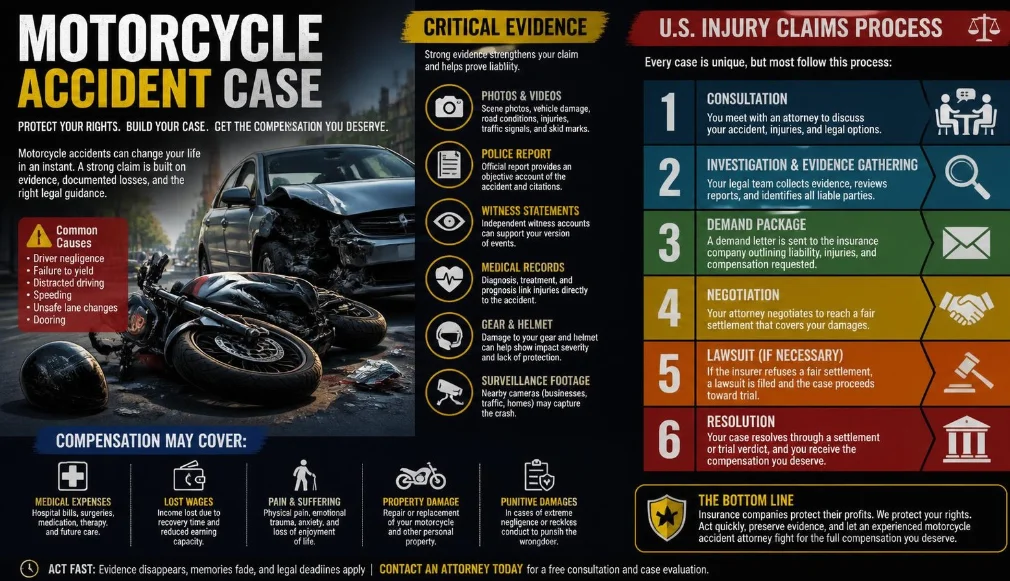
Strong evidence helps establish what happened, who caused the collision, and what losses followed. Some evidence can disappear within days or even hours. Preserving available information early can therefore become important.
Useful evidence may include the following items.
- Police or crash reports.
- Photographs of vehicles and the roadway.
- Helmet, clothing, and damaged riding gear.
- Dashcam, traffic-camera, or business surveillance video.
- Witness names and contact details.
- Medical records and diagnostic results.
- Ambulance and emergency-room records.
- Repair estimates and motorcycle photographs.
- Pay records showing missed work.
- Insurance policies and claim correspondence.
Medical documentation can be especially important when an insurer disputes injury severity. Consistent treatment records can show symptoms, diagnoses, limitations, and recommended care. Gaps in treatment may also become an issue during claim evaluation.
Digital evidence deserves prompt attention because recordings may not remain available indefinitely. Nearby businesses could routinely overwrite security footage. A written preservation request may sometimes be appropriate when valuable video exists.
How Is Fault Determined After a Motorcycle Crash?
Fault is normally determined from evidence rather than assumptions about the rider or driver. Investigators may examine vehicle positions, traffic controls, road conditions, statements, video, and physical damage. Expert reconstruction may become useful when the mechanics of a serious collision remain disputed.
A police report can provide valuable information, but it may not decide civil liability by itself. Insurers can conduct their own investigations and reach different conclusions. A court can also evaluate evidence independently if the dispute becomes a lawsuit.
U.S. states do not all use the same shared-fault system. Cornell Law School explains that comparative negligence can reduce damages according to the claimant’s assigned percentage of fault. Some jurisdictions use different versions of comparative fault, while a smaller group follows stricter contributory rules.
Helmet use can raise another state-specific question. Failure to wear a helmet does not automatically establish responsibility for causing a collision. Its effect on particular injury damages depends on applicable state law and the facts.
What Compensation May Be Available?
Compensation generally aims to address losses legally caused by the collision. The available categories and proof requirements differ by state. Insurance limits and responsible parties can also affect the practical recovery.
Economic damages can include medical bills, rehabilitation expenses, lost earnings, and property damage. Serious injuries may also create future medical expenses or reduced earning capacity. Those future losses often require stronger medical and financial documentation.
Non-economic damages may address pain, physical limitations, emotional harm, or reduced enjoyment of life. States can regulate these damages differently. Some claims may also involve special statutory limits or restrictions.
There is no reliable national “average settlement” that predicts one person’s result. Injury severity, liability evidence, insurance limits, treatment, lost earnings, and local law can change case value substantially. Comparing an individual claim with an unrelated headline settlement can therefore create unrealistic expectations.
How Insurance Can Affect the Outcome
The at-fault driver’s liability coverage is often an important source of compensation. Yet a serious injury can exceed available policy limits. That makes identifying all relevant policies an important part of claim evaluation.
A rider’s own coverage may also matter in some situations. Uninsured or underinsured motorist coverage can become relevant when the responsible driver lacks sufficient insurance. Policy wording and state insurance law determine whether that coverage applies.
Insurance adjusters commonly request documents and statements while evaluating liability and damages. Claimants should understand what information is being requested before signing broad releases. Medical authorizations, settlement releases, and recorded statements can have legal consequences.
If a collision also produces citations or driving charges, the civil injury claim and traffic matter should be distinguished. Justibyst’s Traffic Attorney Guide explains how driving offenses, evidence, court appearances, and license consequences can operate separately.
Settlement Versus Filing a Lawsuit
A claim often begins with insurance investigation and settlement discussions rather than a court filing. The parties may exchange medical records, bills, wage information, photographs, and liability evidence. Negotiations can continue until an agreement is reached or the dispute remains unresolved.
A lawsuit begins a formal litigation process with court deadlines and procedural rules. Pleadings, discovery, depositions, motions, expert evidence, and trial preparation can follow. Many filed cases still resolve before a trial occurs. You might also like McCulloch v Maryland.
Settlement also involves trade-offs. Accepting an agreement can provide certainty and end further litigation risk. A signed release usually prevents the claimant from returning later for additional compensation covered by that release.
Readers unfamiliar with courtroom terminology can review Justibyst’s guide to what a litigator does. It explains how negotiation, discovery, motions, and trial preparation fit within civil disputes.
How Long Do You Have to File?
Every state imposes deadlines for injury lawsuits, generally called statutes of limitations. The applicable period can vary based on jurisdiction, claim type, injured person, and defendant. Missing the controlling deadline can prevent an otherwise valid claim from proceeding.
Nolo notes that common limitation periods for motor-vehicle injury lawsuits are often two or three years. Some states allow less or more time, however. Claims against government entities can also involve much shorter notice requirements.
An insurance claim does not necessarily stop the lawsuit deadline from running. Ongoing negotiations can continue while the statutory period approaches. Riders with serious injuries should therefore identify the correct state deadline early.
What If the Rider Was Partly at Fault?
Partial responsibility does not always eliminate a claim. The outcome depends on the fault system used by the applicable state. A percentage assigned to the rider can reduce recoverable damages in many jurisdictions.
Consider a simple example involving $100,000 in proven damages. If applicable law permits recovery and assigns the rider 20% of the fault, the recoverable amount could be reduced accordingly. This example illustrates the calculation only and does not predict a real result.
Disputes may focus on speed, lane position, signals, visibility, alcohol use, or other conduct. Objective evidence becomes especially useful when both parties tell different stories. Video, physical damage, and independent witnesses can sometimes resolve conflicts more effectively than memory alone.
Steps to Protect a Claim After a Crash
Health and safety come before the legal claim. Emergency treatment should not be delayed to collect photographs or other evidence. Once immediate medical needs are addressed, careful documentation can protect important information.
Practical steps include:
- Get appropriate medical care. Follow recommended treatment and keep copies of records.
- Report the collision when required. State reporting requirements vary by crash severity and location.
- Preserve photographs and video. Save original files rather than edited copies.
- Collect witness details. Independent accounts can help resolve fault disputes.
- Protect damaged property. Avoid disposing of the motorcycle or gear before documentation.
- Keep financial records. Save bills, receipts, pay records, and repair estimates.
- Review insurance communications carefully. Understand releases and authorizations before signing them.
- Identify legal deadlines. Determine the applicable state limitation period as early as possible.
These steps do not guarantee compensation. They can, however, preserve information that insurers or attorneys may need later. A well-organized timeline also makes the claim easier to evaluate.
When Legal Help May Be Useful
Not every minor crash requires litigation or paid representation. Legal advice becomes more relevant when injuries are serious, fault is disputed, several parties are involved, or insurance coverage is uncertain. Short deadlines can provide another reason to seek state-specific guidance promptly.
A lawyer evaluating a claim may review liability evidence, insurance policies, medical records, future losses, and filing deadlines. Counsel can also communicate with insurers and prepare a lawsuit when negotiations fail. The lawyer should be licensed where the claim is being handled.
Credentials and communication should be checked before hiring anyone. Justibyst’s guide on lawyer warning signs explains how to review fees, settlement communications, deadlines, and conflicts.
The Next Step After a Serious Motorcycle Crash
A strong claim begins with accurate evidence, appropriate medical care, and attention to legal deadlines. Riders should preserve available records and avoid relying on national settlement averages or generalized state-law assumptions. The governing law must be checked for the state where the claim belongs.
If injuries are substantial or responsibility is disputed, consider speaking with a licensed attorney in the relevant jurisdiction. Bring medical records, insurance information, crash documentation, photographs, witness details, and a written timeline. Those materials can help counsel evaluate the claim without reconstructing basic facts from memory.
Frequently Asked Questions
How do I know whether I have a motorcycle accident case?
A potential claim usually requires another party’s legally actionable conduct, causation, and documented losses. Evidence must connect the responsible conduct to the collision and resulting harm. A state-licensed attorney can assess those elements under local law.
How much is a motorcycle injury claim worth?
There is no universal settlement amount for these claims. Value depends on liability, injury severity, treatment, income loss, future effects, insurance coverage, and state law. Reliable evaluation requires the facts and supporting records from the specific crash.
Can I recover compensation if I was not wearing a helmet?
Possibly, depending on state law and the injuries involved. Helmet use may affect some damage arguments without deciding who caused the original collision. Courts evaluate the legal effect under the rules of the relevant jurisdiction.
Can I still recover if I was partly responsible?
Possibly, because state fault rules differ across the country. Comparative-negligence systems often reduce compensation according to assigned responsibility. Other jurisdictions can impose stricter limits on recovery.
Should I accept the first insurance settlement offer?
Compare a settlement with documented current and reasonably supported future losses. Signing a release can usually end further claims covered by that agreement. Serious injuries deserve careful evaluation before rights are permanently released.
How long does a claim take?
There is no fixed U.S. timeline. Treatment duration, liability disputes, insurance limits, expert reviews, negotiations, and litigation can all affect timing. A straightforward claim may resolve sooner than a case involving major injuries or contested fault.